

What is included in Revisited Races?
Building upon the legacy of Pathfinder First Edition, and the existing d20 game system which is over 40 years in the making, Intrepid Realms RPG: Revisited Races includes a new look at over 75 races suitable for play at 1st character level, and beyond.
Each race has been rebuilt using our own adaptation of the Race Point system, aligning each to the same power level (20 RP).
From kobold to sasquatch, all races are created equal, so no matter what your character concept, you will be sure to make your mark on the world!
Intrepid Realms RPG: Revisited Races includes:
- Fully rebalanced versions of over 70 Legacy Races first introduced in Pathfinder First Edition, nearly all of which include additional racial traits to bring them in line with the same starting capabilities.
- An introduction to 14 brand new or deeply expanded playable races with full racial details, including Demi-Humans, Giantborn, Immortis, Rabbitfolk, Minotaurs, and Volaris.
- Over 1,200 new alternative racial traits, to make sure you get the most out of every one of your character concepts.
- Over 1,000 monstrous racial traits, allowing for more powerful races such as dragons, drow nobles, and genies, to acquire their strongest abilities at the right levels.
- A selection of new character options, including the exemplar class, gear, race-specific archetypes, racial trait-specific favored class bonuses, and universal archetypes suitable for any character.
Grab yours today, either as a physical copy or a digital download.
Check out our reviews
"Right off the bat I want to say, this book is fantastic. 5 out of 5. The creativity on display in this book is excellent! My only complaint is that the Intrepid Realms RPG in-house adaptation of the Race Point system was not included in the book ,along with how to create the Monster Racial Traits and how to calculate the beginning play level of a race. I also really wish that they had included the RP breakdown cost for each race and ability. This would make it much easier for their customers to create their own races. Hopefully this will be released in the future as an independent document or as an addendum to this book."
- Christopher (Rating: 5/5; Review from DriveThruRPG.com)
"I purchased Sunburst Games' Intrepid Realms RPG - Revisited Races (Pathfinder First Edition) a little while ago, but only just finished reading it now, and I have to say that it's been a while since I've been this impressed.
Over four hundred pages in length, replete with gorgeous full-color art, showcasing not only a precise grasp of rules but also penetrating insights by way of small-but-brilliant innovations, this book of over one hundred races for PF1—along with several supplementary offerings—is astounding to see, all the more so when it's a company's freshman offering.
Except that this isn't Sunburst Games' freshman offering.
In fact, the company actually appeared back in late 2018, where its initial release was Realms of Atrothia: Legacy Races Revisited, a book that—like this one—re-balances a number of extant PF1 races. It was apparently meant to prime the pump for their ambitious Kickstarter in early 2019, which unfortunately came nowhere near its target. Never having heard of either Legacy Races Revisited or their Kickstarter prior to a few days ago, I can only presume that their attempt to drum up exposure for their Kickstarter via their first product proved insufficient, after which Sunburst Games sank into quiescence.
Until now.
More than ten times the page-count of their initial offering (but take note that the page-count on the DriveThruRPG sales page is slightly off; this PDF is 438 pages, not 464), Revisited Races returns to their original concept of re-balancing existing races in PF1, alongside offering new material for them. But having picked up a copy of their 2018 sourcebook, I can say that the differences between that supplement and this one are like the differences between a tricycle and a space shuttle. There's simply no comparison.
I barely know where to begin, so I'll start with a high-level overview of what's here. To reiterate on what you'll see in the table of contents:
• After the introduction and overview, we get fourteen Primary Races. Each of these is a new race, with not only expanded flavor text (i.e. covering physical description, their society, example names, and quite a bit more) and full set of racial stats (which are basic stats, alternate racial traits, racial variants (i.e. sub-races), and monstrous racial traits; more on those below), but also include things like racial feats specific to that race, a generous listing of favored class bonuses for various classes, and even a racial archetype for a particular class.
• Then comes seventy-four Legacy Races, which are existing races from PF1. All of these have much shorter flavor text, and no instances of racial feats, favored class bonuses, or class archetypes, instead limiting themselves to the basic racial information, racial variants (if any), and monstrous racial traits.
• Next we get fourteen Monstrous Races, which are creatures (some new, some from PF1) which have traditionally not been offered as PC races. As with the legacy races, these have abbreviated flavor text and no race-specific feats, archetypes, or favored class bonuses, sticking to the usual racial information, alternate racial traits, racial variants (if any), and monstrous racial traits. However, I should mention that several of these have expanded racial variants and monstrous racial traits entries, because the monsters they represent have various sub-categories which necessitate the expanded treatment. For instance, you're playing a sphinx, you can choose traits particular to a certain kind of sphinx; if playing a genie, you can choose traits particular to a certain kind of genie; if playing a dragon, you can choose traits belonging to certain dragons, etc.
• After this comes eight Hybrid Races, which are entries for creatures that we'd normally treat as templates (e.g. half-dragons, grave knights, vampires, etc.). Here, the template format has been done away with, instead giving us (after the flavor text) long lists of monstrous racial traits that can be taken to customize how your character's unusual heritage manifests.
• Finally, we come to the Supplemental Content, which includes a new class, several new archetypes, APG-style traits, new and revised feats, new and revised spells, and even new and revised monster qualities; I should add that it's in these revisions that some of the subtlest and most impressive revisions are to be found.
Still following along? Because I've barely scratched the surface.
I should note that, if you poke around the Sunburst Games website, you'll notice that they make references to their Intrepid Realms RPG being a revision of Pathfinder 1E. Having read Revisited Races cover-to-cover, I can say that it does come across that way. However, the revised versions are subtle enough that I wouldn't call this PF1.5. I wouldn't even call it PF1.1. Rather, this strikes me as being a PF1.01...but that .01 change is nothing less than genius, and I don't say that lightly.
For an example of the brilliance at work, each race's flavor text concludes by not only putting their vital statistics tables (i.e. their starting age, age categories, and height and weight listings) right up front—which is already a smart move, since those are quite often forgotten when publishers introduce new races—but there are also entries for each race's clerical domains, favored weapon, typical alignment, and typical level and commonality (with notations for sub-races).
Now, that last part might sound a bit odd; aren't clerical domains and favored weapons supposed to be part of a deity's entry? Yes, normally; but the book's introduction makes it clear that this is for if a given race engages in ancestor worship, rather than following a particular god. It's an insightful way of lampshading giving each race a small set of thematic spells (since that's what domains are) and a particular weapon—which is very helpful when you get to the supplementary content—but also suggests in-character material that helps to flesh out each race in particular. It's a masterful blend of fluff and crunch which is sure to fire the imagination, and that's before we've gotten to the racial abilities!
As I noted before, each race has three or four listings when it comes to their mechanics. To break it down in more detail I'm going to use another set of bullet points:
• Racial Traits are the basic mechanics of each race. One thing to be cognizant of here is that even the "legacy races" (i.e. races which have already been published for PF1) are different from their standard presentation; the basic racial traits for a human, a catfolk, or a dhampir (to name a few) that you've seen in Paizo products are not the same as what you'll find here. That's because each race has been re-balanced to be worth 20 race points, which is far and away higher than what most races originally had, though here the additional values are put towards versatility more than power. (With that said, it's worth noting that Revisited Races doesn't list the RP costs for any racial features; presumably this is because they've changed some aspects of how the system works, apropos to their subtle tweaks of the PF1 game system).
• After this we have the Alternative Racial Traits, which I suspect most PF1 aficionados are familiar with. Simply put, these are racial traits that can be substituted for a "common" racial trait when making your character, with each one specifying what common trait you swap them out for. However, in one of the many twists unique to this book, you can instead purchase an alternative racial trait with the Extra Racial Trait feat (new to this book), which I should note allows you to purchase a common race trait that you've given up for an alternative trait, or allows you to purchase an alternative racial trait you didn't want to take for your character initially.
• Not all races have Racial Variants, which as noted are essentially sub-races. These are themed packages of alternative racial abilities, though in many cases what's here are a combination of alternative sizes (e.g. playing a Small character instead of a Medium one) and ability score modifiers. It's worth noting that you cannot purchase a racial variant with the Extra Racial Trait feat. I should also mention that each sub-race has its own name, and at least a sentence of flavor text to help establish its identity.
• Finally, we come to Monstrous Racial Traits, which are essentially alternative racial traits that can only be purchased via the Extra Racial Trait feat. Further, each one has prerequisites, which include a minimum character level and usually several other character traits (be they common, alternative, or even other monstrous racial traits). It's through this system that the book allows for stronger-than-normal abilities to be purchased. Having mentioned so much about the book's mechanics, this might be a good time to talk about the artwork.
While the Sunburst Games website says that they're not averse to using AI, it also specifies that their policy is to do so only if they can't afford commissioned work and can't find appropriate stock art. Neither of which seems to be the case here, as all of the art is either commissioned or stock art. I can tell because not only do they have a page crediting their artists and specifying who did what (and what page it's on), but because each piece of art—and there is a lot, with each race having at least one full-color piece—allows you to view a text description of the piece and who made it if you hover the mouse over the image. I'm not sure if that's an innovative way of expanding the information available (a few pieces give proper names to the characters depicted) or if it's part of a text-to-speech program for the visually-impaired, but it's extremely cool.
So we get over a hundred races with all of that (keeping in mind that not all races have racial variants, and that the "hybrid races" consist of flavor text and monstrous racial traits), which is already a feast of new content...and then we come to the supplementary materials.
You might think that after having done so much, Sunburst Games would have rested on their laurels here, but you'd be wrong.
For me, the supplementary content was some of the best parts in the book.
Let's start with its new base class, the exemplar. Without going too deep into the weeds, this class is actually something of a meta-class which is designed to play to a given character's racial abilities. For instance, the class's Hit Dice, BAB progression, saving throw progressions, and even skill points per level are determined via your creature type (and don't worry, fey characters; this doesn't stick you with the lousy d6 and half-progression BAB that the fey creature type traditionally receives). Beyond that, it also grants a generous selection of bonus feats (which must be racial) and inherent talents (which augment and expand on racial traits)—among other options—to let you expand on your character. (And while it doesn't offer full-progression spellcasting like a wizard or cleric, there are options here if you want to focus on a character with magical abilities.)
After a list of exemplar favored class bonuses (all of which can be taken by any race), we then get a series of eleven class archetypes—one for each of the basic PF1 character classes—that make them a little bit more like an exemplar, letting characters bring more of their racial abilities to bear in conjunction with the class in question.
And as if that wasn't enough, then we get a series of universal archetypes, which are essentially class archetypes that aren't tied to a class. Here, you give up some combination of your favored class bonuses, the feats you receive at odd-numbered levels, and the ability point you get at every fourth level, in order to receive the universal archetype, which can range from things like "beastmaster" to "white mage." With over two dozen to choose from, the customization options boggle the mind.
After a couple of new clerical domains and APG-style traits (and drawbacks), we start coming to areas where Sunburst Games has innovated on existing content (notwithstanding the re-balanced legacy races), as we get a combination of new and reworked feats and spells. For what it's worth, this was when I started to realize that I was seeing something really special, because the changes made here are small but dramatic. For instance, a large number of the re-worked spells are cantrips, which have been rewritten so that they now scale upward in the damage they can do. It's not dramatic, but rather (in what I'll admit seems like a nod to 5E) allows for them to actually remain relevant past the first two or three levels; they're never going to be any spellcaster's first choice of spells, but if you find yourself facing an enemy that's vulnerable to cold, something like ray of frost is actually worth using now, rather than being little better than a wasted action.
On the other end of the scale, the ways in which they've expanded on what wish can do are impressive, and give the clearest hint in the book at how future supplements will revise further parts of the PF1 game engine.
After this comes a selection of new weapons (since several races have "weapon familiarity," which gives them proficiency with a group of weapons alongside any weapon with their race's name in its listing...so of course, new weapons with those races' names have to be presented here, along with new non-magical weapon qualities), as well as a selection of tweaked versions of familiar simple monster templates, we finally come to the last section of the book, which is an expansion of universal monster rules.
One thing you'll notice here is that a lot of non-standard monster qualities have been standardized here. Like, being held at bay by something that's anathema to you (e.g. like when you show a vampire a holy symbol) is now the "abeyance" quality; similarly, always being treated as having a running start when you make an Acrobatics check to jump is the "jumper" quality. But what makes this brilliant are how several familiar qualities are tweaked.
For instance, having "construct traits" is for the most part what you'd expect. But there's a few new points to be found in the paragraphs of description, such as using your Intelligence score when calculating functions that would normally use Constitution (e.g. bonus hit points, Fortitude save bonus, etc.). That's in addition to keeping the size-based bonus hit points that constructs receive. But more than that, it explicitly specifies that you can bring a destroyed construct back with spells such as greater make whole or even just the Craft Construct feat, though there's a gp cost that makes doing so comparable to casting resurrection. Little things like this are everywhere in this section; the "darkvision" trait now states that if you receive darkvision from more than one source (e.g. a class feature and a racial trait) you increase the range of your darkvision by +30 feet each time. "Rock throwing" specifies the damage of the thrown rocks by size category, as well as clarifying that any "hefty, blunt" object with at least hardness 5 is considered to be a rock for purposes of that ability. It's little clean-ups like this that make this section so great.
This is the book that Paizo should have written ten years ago.
Now, for all of my gushing, I can't say that this book is absolutely flawless. For instance, I've already mentioned that the book has no Race Point listings for its various traits, and while that's likely due to its changing various small aspects of the system, I can't help but think that if you call out the "20 RP standard for all races" thing right there on the sales page, you're inviting people to expect that you'll show your work on that.
Moreover, I question some of the categories into which certain races are placed. For instance, remember how I said that the fourteen primary races were all new? Well, the rougarou is one of them, and it's a race we've seen before in PF1. By contrast, we have several new races among the "legacy races" (and among the monstrous race) that are entirely new. The helionan, the necrite, the silveign, the stygian...all are new, yet aren't given the full listing that the primary races are, which isn't just a matter of reduced flavor text; not having racial-specific favored class options means that these races take a (very minor) hit to their versatility.
Finally, there's an issue of a tiny amount of information that should be here not being present. For instance, new creature subtypes; if you're playing an immortis or a graveknight, for instance, you're going to be an undead with the "corpse subtype," but that subtype isn't to be found here. (I'm also not sure if the "corruptor" quality is presented correctly, since having it means that you automatically fail saving throws against mind-affecting effects...when they're used by another creature with the "corruptor" quality; is there something there that I'm not understanding, or is that meant to make it so that creatures with that quality can automatically affect each other's minds with their powers?)
But those are really just tiny complaints. On a five-star scale, the book is easily worth 4.99 stars by any margin. There's just too much high-quality content here not to overlook the few areas that are slightly less than perfect.
As it stands, I strongly recommend this to everyone who's even remotely interested in PF1. You'll be using what's here for years to come, and your characters will be that much more interesting for it. Given that this is only the first of several new books that Sunburst Games apparently has in the works, we’re definitely looking at a PF1 renaissance in the very near future!"
- Shane (Rating: 5/5; Review from DriveThruRPG.com)
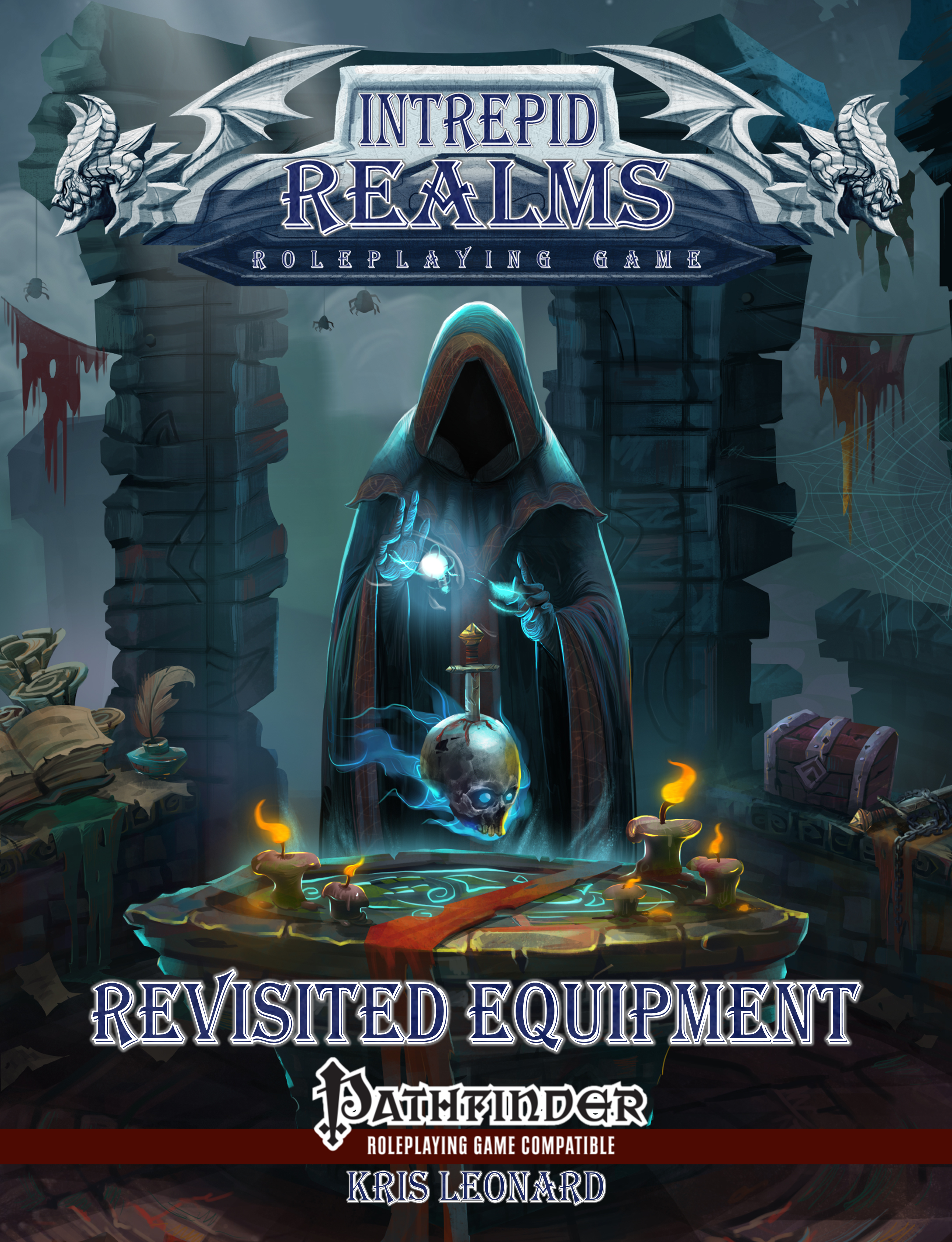
What is included in Revisited Equipment?
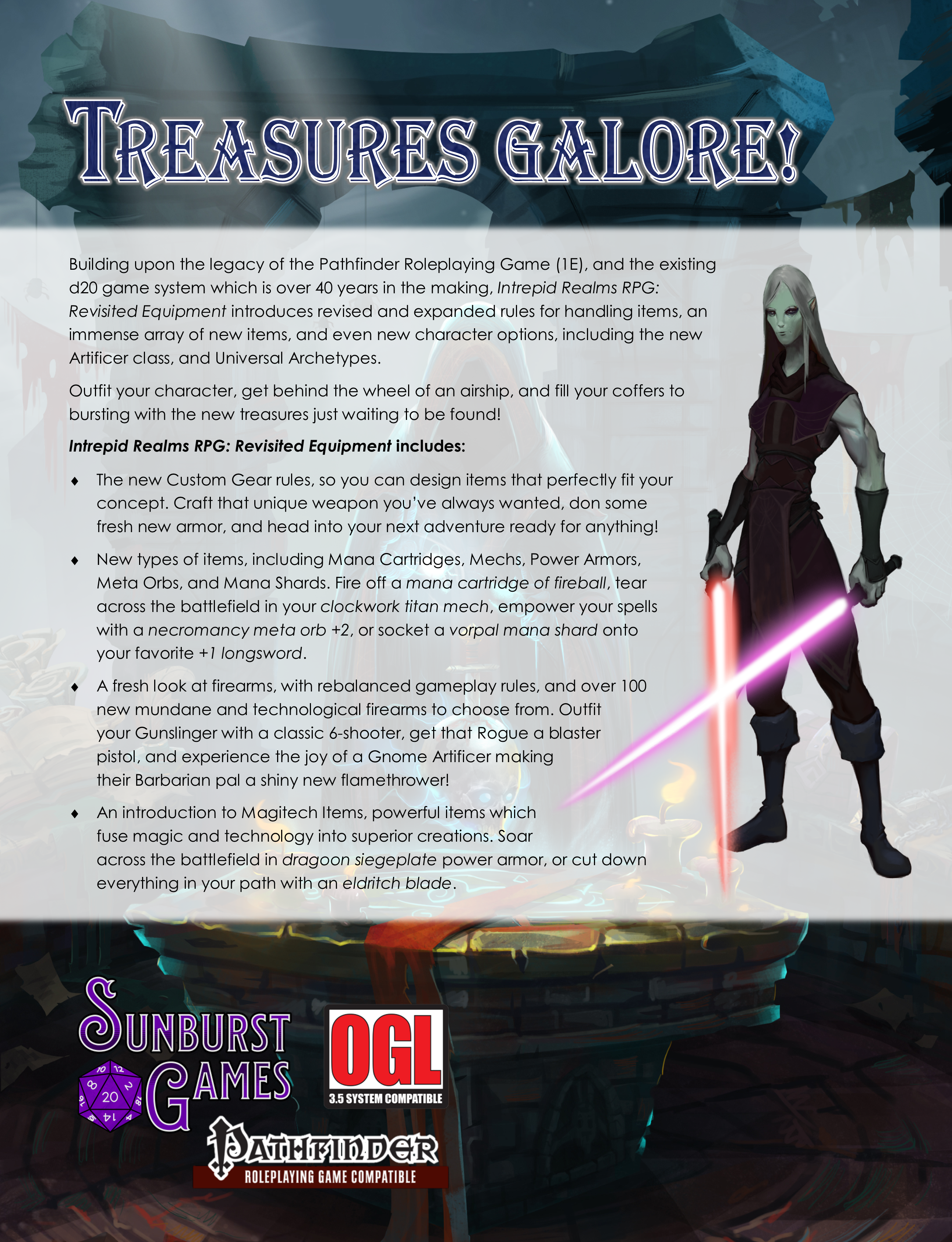
Building upon the legacy of Pathfinder First Edition, and the existing d20 game system which is over 40 years in the making, Intrepid Realms RPG: Revisited Equipment introduces revised and expanded rules for handling items, an immense array of new items, and even new character options, including the new Artificer class, and Universal Archetypes.
Outfit your character, get behind the wheel of an airship, and fill your coffers to bursting with the new treasures just waiting to be found!
Intrepid Realms RPG: Revisited Equipment includes:
- The new Custom Gear rules, so you can design items that perfectly fit your concept. Craft that unique weapon you’ve always wanted, don some fresh new armor, and head into your next adventure ready for anything!
- New types of items, including Mana Cartridges, Mechs, Power Armors, Meta Orbs, and Mana Shards. Fire off a mana cartridge of fireball, tear across the battlefield in your clockwork titan mech, empower your spells with a necromancy meta orb +2, or socket a vorpal mana shard onto your favorite +1 longsword.
- A fresh look at firearms, with rebalanced gameplay rules, and over 100 new mundane and technological firearms to choose from. Outfit your Gunslinger with a classic 6-shooter, get that Rogue a blaster pistol, and experience the joy of a Gnome Artificer making their Barbarian pal a shiny new flamethrower!
- An introduction to Magitech Items, powerful items which fuse magic and technology into superior creations. Soar across the battlefield in dragoon siegeplate power armor, or cut down everything in your path with an eldritch blade.
Coming soon, either as a physical copy or a digital download.
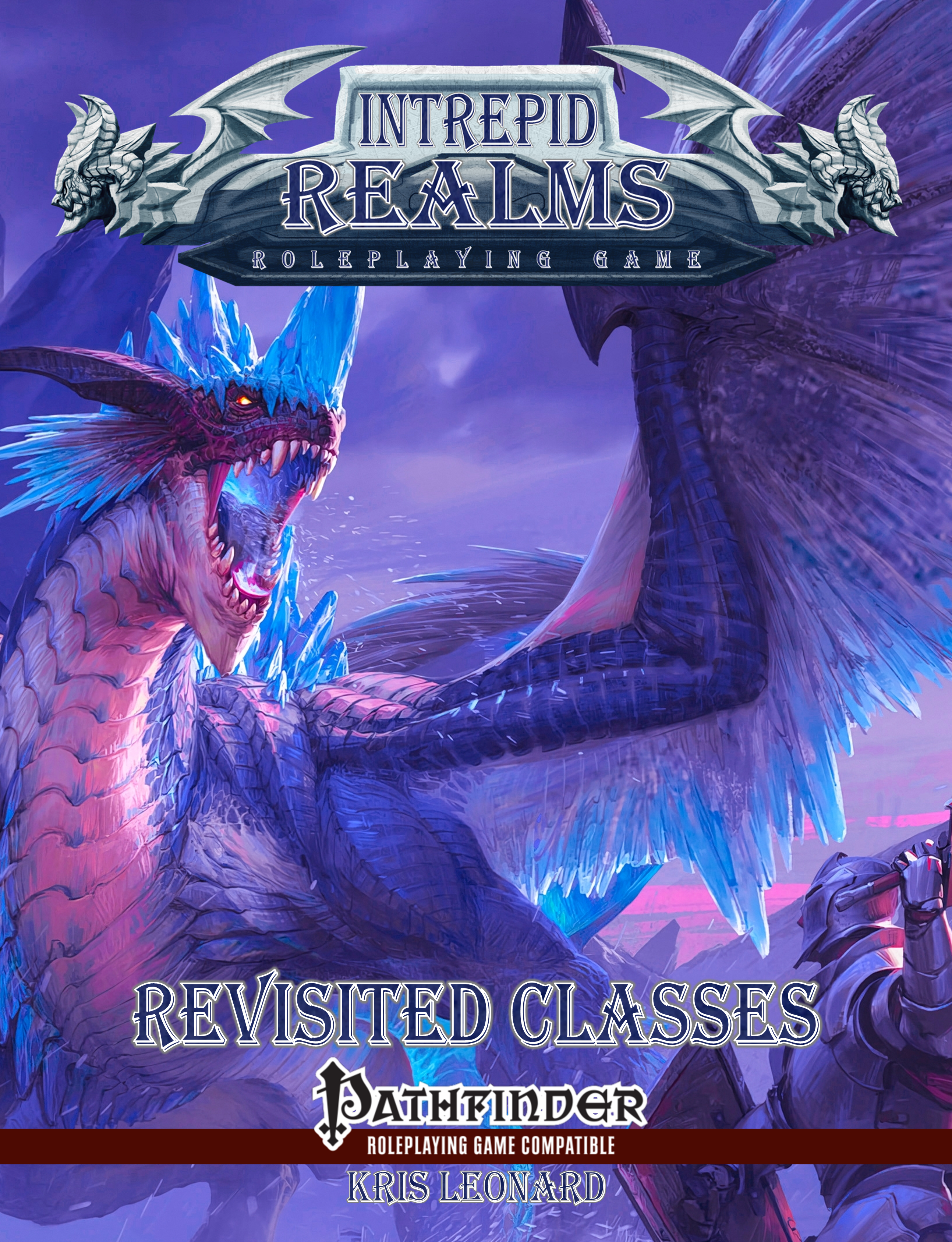
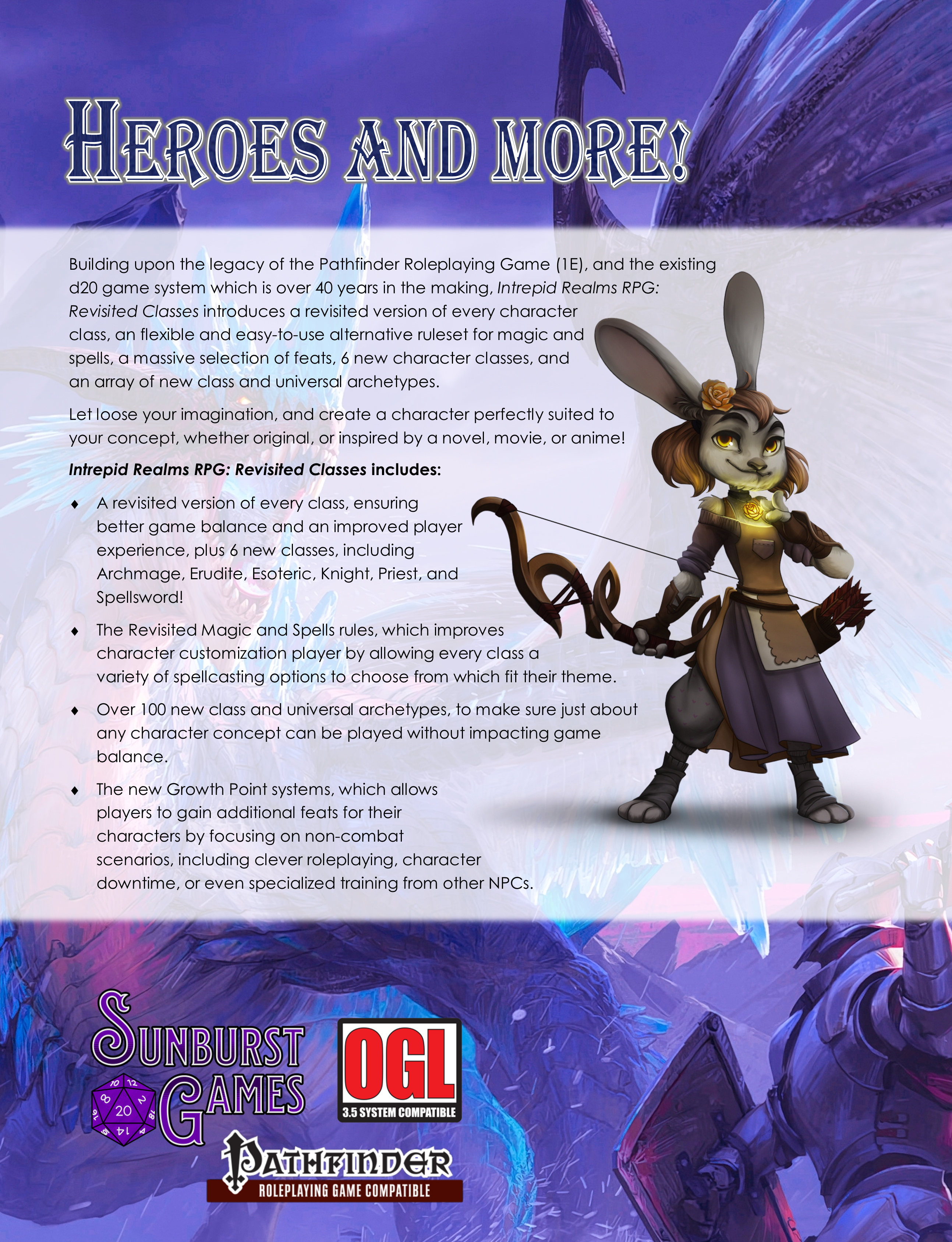
What is included in Revisited Classes?
Building upon the legacy of Pathfinder First Edition, and the existing d20 game system which is over 40 years in the making, Intrepid Realms RPG: Revisited Classes introduces a revisited version of every character class, an flexible and easy-to-use alternative ruleset for magic and spells, a massive selection of feats, 6 new character classes, and an array of new class and universal archetypes.
Let loose your imagination, and create a character perfectly suited to your concept, whether original, or inspired by a novel, movie, or anime!
Intrepid Realms RPG: Revisited Classes includes:
- A revisited version of every class, ensuring better game balance and an improved player experience, plus 6 new classes, including Archmage, Erudite, Esoteric, Knight, Priest, and Spellsword!
- The Revisited Magic and Spells rules, which improves character customization player by allowing every class a variety of spellcasting options to choose from which fit their theme.
- Over 100 new class and universal archetypes, to make sure just about any character concept can be played without impacting game balance.
- The new Growth Point systems, which allows players to gain additional feats for their characters by focusing on non-combat scenarios, including clever roleplaying, character downtime, or even specialized training from other NPCs.
Coming soon, either as a physical copy or a digital download.


What is included in Realms of Atrothia?
Building upon the legacy of Pathfinder First Edition, and the existing d20 game system which is over 40 years in the making, Intrepid Realms RPG: Realms of Atrothia introduces the Atrothia campaign setting, which can be seamlessly connected to any other game worlds.
All the cosmos is at your fingertips with the introduction of the Worldwell, forged eons ago by the mysterious Dregarion Empire, your heroes’ next legendary journey need only be a step away!
Will you brave the pirate infested waters of the Blood Seas, or would you rather earn your fortune among the Guild-Cities of Perthia? Can you survive amongst the vampiric aristocracy of the Hegemony of Kalmarune? Do you dare to enter the vast untamed wilds of the Mogen Wildlands, to discover relics of Old Dregarion among the slumbering Kaiju? Or would you rather see what lurks beyond the Everfalls of the World’s End? Get ready for a while new world of adventure!
Intrepid Realms RPG: Realms of Atrothia includes:
- Discover everything you need to know about Atrothia’s unique landscape, including vital details about countries, political alliances, major cities, and even geographical sites.
- The Atrothian Pantheon, complete with details about Atrothia’s primary deities, including Domains, Favored Weapons, and Ascended Tier.
- An introduction to the new Ascended System, so you can take your characters beyond level 20! This easy-to-use ruleset is infinitely scaling, and includes the Ascended Monster simple template to easily convert existing materials as you play.
Coming soon, either as a physical copy or a digital download.
Need a Character Sheet?
Keep it old school with the official Intrepid Realms RPG: Character Sheet. Track your character using this printable, pen-and-paper classic, featuring larger fields, and a sleek modern twist.
Need a Digital Character Sheet?
We've got the device-users covered with the official Intrepid Realms RPG: Fillable Character Sheet. Track your character using this form-style PDF, featuring auto-calculating fields where you need them most.
Where is the existing content?
The Intrepid Realms RPG is designed to seamlessly fit with the existing content for Pathfinder First Edition. To view all the available materials, check out the official PRD on Archives of Nethys at aonprd.com.
What is Pathfinder First Edition?
Pathfinder First Edition is a Tabletop RPG based on the d20 game system. Learn more about the Pathfinder First Edition at paizo.com/pathfinder.
Compatibility Licenses
Pathfinder and Starfinder are registered trademarks and copyrights of Paizo Inc. The Pathfinder and Starfinder Compatibility Logos are trademarks of Paizo Inc. The Pathfinder-Icons font is a copyright of Paizo Inc. These trademarks and copyrights are used under the Paizo Compatibility License. See paizo.com/licenses/compatibility for more information on this license.
Pathfinder, Starfinder, and associated marks and logos are trademarks of Paizo Inc., and are used under license. See paizo.com/pathfinder and paizo.com/starfinder to learn more about Pathfinder and Starfinder.